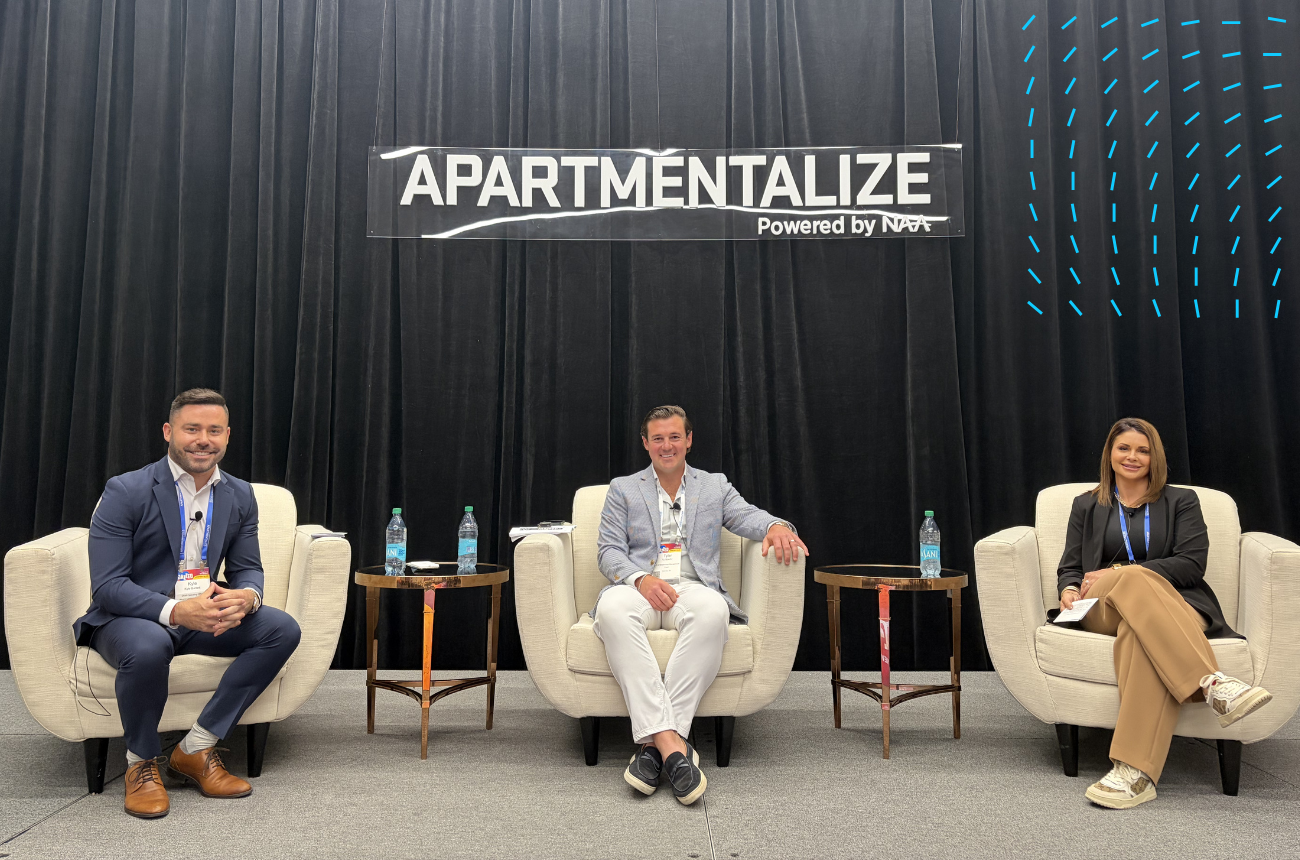
On June 19, 2026, Foxen participated in an education session at NAA Apartmentalize in New Orleans that drew a packed room of multifamily operators, owners, and property management professionals. The session — Paws, Policies, and Problems: The Great Pet Management Reality Check — brought together three panelists for a data-driven, candid conversation about one of the most challenging aspects of running a multifamily portfolio.
Hosted by Ty Specht, VP of Relationship Management at Foxen, the panel featured Foxen customers Rachel Rountree, SVP of Operations at University Partners, and Kyle Burkett, COO at Nicol Investment Company. Here are the key takeaways from the session.
1. Pet Ownership isn't a Niche, It's the Norm
The session opened with a data point that framed the entire conversation: 59% of renters now have pets, up from 46% in 2019. Renter households are now more likely to have a pet than a child. And a majority of renters say pet-friendliness is essential when deciding where to live.
The industry has largely made the call to be pet-friendly: 93% of operators allow pets in at least some capacity. The real question, as Ty framed it at the outset, is no longer whether to allow pets, it's how well properties are managing them.
Both Rachel and Kyle spoke to how pet-friendliness has evolved in their portfolios. At University Partners, it means a structured, intentional program — every resident completes a pet verification profile at application and agrees to pet policies whether or not they have a pet. At Nicol, it means viewing pets through a lens of NOI and risk, investing in amenities like pet wash stations and dedicated outdoor spaces, and leaning on technology to handle compliance without burdening on-site teams.
2. The Operational Reality is Messier than Most Operators Admit
Foxen's Multifamily Pet Management Trends Report paints a clear picture of where pet management breaks down operationally. The numbers are striking: 86% of operators worry about liability and safety risks; 79% worry about property damage; 3 in 4 experience difficulty enforcing pet policies; 50% say they spend too much time chasing residents for correct documentation; and 42% can't easily access pet information when they need it.
Kyle spoke to the liability dimension candidly. His company Nicol has experienced two dog bite incidents that have made their way to attorneys, both involving ESA animals. "The multifamily landscape continues to be more litigious. As a landlord, we're liable for what happens. Even if we do all the right things, we can get sued for negligence."
Rachel's approach at University Partners is to treat documentation as a compliance function, not a leasing task. The biggest operational shift has been requiring documentation at application — not as a follow-up that gets deprioritized.
3. ESA Misrepresentation is Widespread — and the Reasons are More Complicated than Fraud Alone
The panel discussed the challenges of emotional support animals, which panelists called the most complicated piece of the pet management puzzle. Foxen's report found that 75% of operators say ESA requests have increased over the past five years, 80% are concerned about fraud or misrepresentation, and 53% have noticed an increase in residents misrepresenting household pets as ESAs.
Kyle shared a striking example from Nicol's Tampa market, where getting an ESA letter has become, in his words, as easy as logging into Facebook. The financial impact is measurable: "At Nicol, we attribute $102 of other income per unit to pets — that's your one-time pet fee plus ongoing pet rent. In Tampa, our per-unit income from pets has dropped to $67. That's $35 per unit of revenue lost to ESA fraud, with no control at the property management level. It feels like we're burning the candle at both ends."
But the panel was quick to add important nuance: in many cases, misrepresentation isn't driven by bad actors, it's driven by renters who are out of options. 43% of restricted-breed owners have had difficulty finding affordable housing because of their pet. One in three has been rejected from a rental application because of their dog. And 14% of dog owners have registered their dog as an ESA specifically to avoid pet fees or breed restrictions.
Both Kyle and Rachel emphasized that the answer isn't stricter enforcement applied inconsistently — it's a documented, standardized process applied to every request, without exception. As Rachel put it, improper denial is a Fair Housing violation; but inadequate verification creates fraud that ultimately harms residents with legitimate needs.
4. The Recent HUD Assistance Animal Memo Changes the Calculus
One of the session's most timely moments came when the panel discussed a HUD internal memo issued on May 22, 2026, just weeks before the conference. The memo explains that untrained emotional support animals will no longer be treated the same as trained service animals for purposes of accommodation complaints.
Important caveats: private litigation is unaffected, and state and local fair housing laws remain unchanged. Operators cannot treat this as a blanket justification to deny ESA requests.
The panel's reaction was cautiously optimistic. Kyle noted that for years, the standard operating procedure has been to accept any letter bearing the word "doctor" — because until now, challenging it simply wasn't worth the Fair Housing litigation risk. "As an ownership group, we don't even ask for that challenge — the juice is not worth the squeeze. Litigation around Fair Housing is much more expensive than losing a $250 or $350 pet fee."
The HUD memo, Kyle said, gives operators something they've been missing: room to push back against questionable ESA letters. He added that Nicol is leaning toward honoring accommodations made before the rule change, citing resident trust as too important to sacrifice — particularly in a market with occupancy challenges.
Foxen’s CEO, Kevin Jacobson, recently supported this sentiment by stating, “What remains true is that residents care about their pets and animals—and the way operators navigate this change will impact resident satisfaction, loyalty, and retention rates. “
For the industry, the takeaway from the panel was clear: this memo is a step forward, but there are still many unanswered questions. Operators still need a documented, defensible process for every accommodation decision. A clear paper trail matters more than ever.
5. Revenue Leakage is Real, and Most Operators Aren't Measuring it
A live audience poll during the session asked whether operators believed they were capturing 100% of pet-related revenue. The responses confirmed what the data suggests: most aren't — and many have never measured it. Foxen’s report found that 1 in 3 operators believe pet fees aren't being collected correctly, and 78% are concerned about lost revenue from pet fees due to animal misrepresentation.
Rachel shared that University Partners closed revenue gaps by cross-referencing online pet profiles against resident accounts in Entrata. She revealed that properties using structured tracking report roughly 46% pet prevalence versus 40% for those without formal systems — real, recoverable revenue. University Partners has also added automatic flea treatments as a standard lease charge in pet units, addressing a cost the company was absorbing and setting clear expectations upfront.
Kyle's approach in high-fraud markets may seem counterintuitive at first: Reduce pet fees to make the ESA workaround less attractive. He made the point with this example — an apartment building in Philadelphia charging $750 for a one-time pet fee. "As an industry, I think we can do a little better than that. If you have a 10,000-unit portfolio and 15% are getting fake letters, instead of raising fees in 2027 and driving your consumer to be sneakier — let's get back to reality on what we charge, and make sure we communicate that value in the leasing office."
6. Breed Restrictions Deserve a Harder Look
One of the more memorable moments in the session came when Rachel shared her perspective on breed restrictions and her personal stake in the debate. "I am a pit bull owner. I think we need to take a real look at breed restrictions. I've experienced dog bites in the past, and they've never been that type of breed. My motto is: bad owner, bad dog. Every dog bite I've ever experienced has never involved something on a restricted breed list."
The data backs up her call for a more nuanced approach. According to Foxen’s research, only 26% of operators collect bite history, and just 31% ask about behavioral concerns — meaning most breed restrictions are rooted in assumptions, not individual pet data. Behavior-based screening is more accurate, more inclusive, and reduces potential litigation exposure from blanket breed bans.
Kyle added that breed restrictions have been standard practice for essentially his entire career in multifamily — making the call to revisit them a meaningful shift in industry thinking.
7. The Future of Pet Management is Data-Driven, Fair, and Sustainable
Ty closed the session with a framework that tied together everything the panelists had discussed: the future of pet management needs to be data-driven, fair, and sustainable.
Data-driven means going beyond move-in snapshots to collect ongoing information across the portfolio, tracking how many household pets, ESAs, and service animals are in each community, how that correlates to fee structure, and using that data to make better decisions. As Ty put it, for a long time operators have had limited visibility into this data. Many haven't been measuring it at all.
Fair means keeping pet fees balanced and transparent — tied to real amenities and value, not arbitrary maximums. And it means asking a harder question about whether breed and weight restrictions are still the right proxy for risk, or whether individual behavior data can serve operators and residents better.
Sustainable means building processes that scale — that make the experience frictionless for residents and manageable for on-site teams. Kyle framed it simply: leasing offices should be leasing, not managing compliance paperwork. "The more we know, the better we are. The more data we have, the better we are. We're all going to get better from here."
Moving Pet Management in Multifamily Forward
The session generated a full room and a lively conversation — from live audience polls to candid exchanges about the ESA requests that have landed on Kyle's desk (including, yes, an emotional support snake). What came through clearly was that pet management, done well, is a genuine competitive advantage in today's leasing environment. Done poorly, it's a liability — financially, legally, and operationally.
Foxen's platform is built to help operators get to that better place: documented, defensible, automated, and resident-friendly. If you want to continue the conversation, reach out to Foxen to learn about our pet management solution, PetClear.
.png)
.png)