
Prepping Your Multifamily Portfolio for 2026
As multifamily operators look ahead to 2026, understanding the economic indicators and operational trends shaping the year will be critical to building a resilient, high-performing portfolio. With market predictions signaling supply drops, tightening competition, and the need for frictionless resident experiences, portfolio leaders must make meaningful changes to realize solid portfolio growth. Residents are increasingly accustomed to convenience and digital experiences in every aspect of their lives, making it more important than ever for multifamily organizations to turn hyped-up technologies and promised improvements into tangible, scalable realities that enhance both efficiency and satisfaction for residents, site staff, and management.
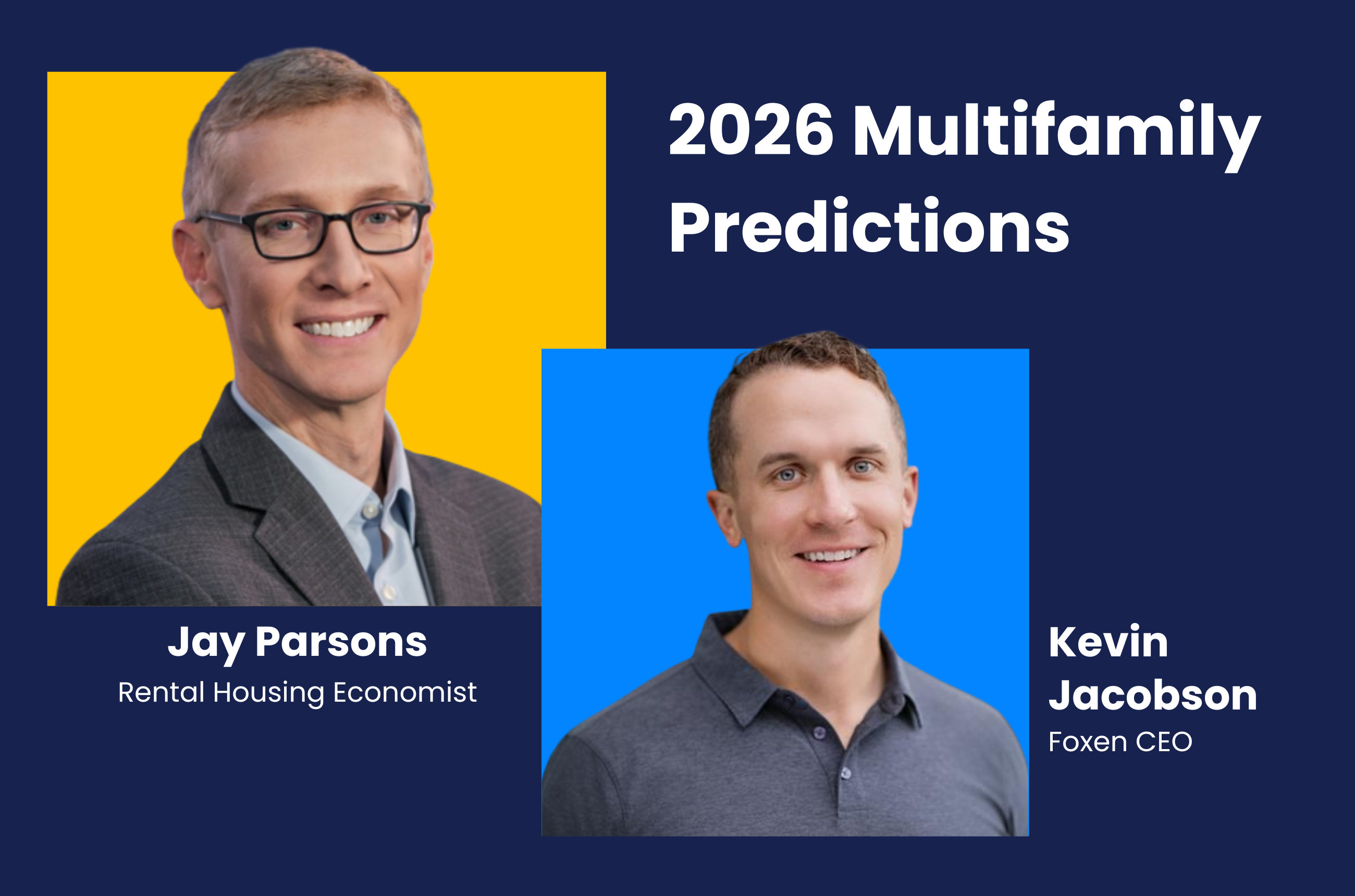
To provide meaningful direction, we’ve gathered market and operational perspectives from two industry experts: Rental Housing Economist Jay Parsons and Foxen CEO Kevin Jacobson. Their combined expertise offers a practical lens into what multifamily professionals can expect—and how to strategically position portfolios for success in 2026.

Market Outlook from Jay Parsons – Rental Housing Economist
First, let’s get this out of the way: The crystal ball is fuzzy these days. Be skeptical of anyone who speaks about a forecast with a high degree of certainty. I wish I had the foresight to be the exception to the rule, but I don’t and I’m not.
But what fun would it be if we didn’t even try? So with the disclaimer out of the way, here’s my take on what that the U.S. apartment industry might see in 2026.
Supply
This is the easiest category to forecast. We only have completed supply in 2026 if we had starts in 2025 or earlier. And we know starts plunged in 2024-25, so that means less supply completing in 2026-27. Completions are likely to come in around 300k in 2026, which is roughly HALF the peak of 2024. Furthermore, it’d be comfortably below pre-COVID norms, too.
We’re seeing that drop in supply in nearly every major market and in every part of the country. So, for operators pummeled by new supply competition in recent years, the tide should start to shift in 2026.
Some markets have already seen supply drops below pre-pandemic norms, including Seattle, Houston, West Palm Beach and even Nashville. Other key markets should get there in the first half of 2026, led by Dallas, Atlanta, Austin, Salt Lake City, Orlando, Denver, Jacksonville and San Antonio. Others – namely Phoenix and possibly Tampa – may not see supply drop below pre-2020 norms until 2027.
Even as completion levels plunge, remember: There’s still a massive wave of completions from 2024-25 to lease up and stabilize. That could take some time, and the pace will vary by market and submarket.
Demand
While supply is pretty easy to pinpoint, demand is not. “Uncertainty” has been a big theme of 2025, and that clouds the demand outlook for 2026. So, let’s look at demand in terms of scenarios.
Upside scenario: If consumer confidence improves and the job market stabilizes, demand should remain strong – or at least very solid. That should allow occupancy rates to rebound from supply-driven lows, though the timing will vary by market.
Downside scenario: If consumer confidence remains weak and the job market further softens, that could limit net new demand. Low turnover could soften the impact on occupancy rates in this scenario, but weak new lease demand likely means a delayed rebound.
In either scenario, absorption (apartment renter household formation) will probably drop off from 2025’s near-record highs … and that’s only because absorption is correlated with supply. With less supply available, there’s less absorption capacity. But reduced absorption isn’t necessarily worrisome for operators if supply drops even faster, allowing vacancy rates to improve.
Also, keep an eye on coastal markets like Boston and Washington, DC, that have relatively little supply completing but saw demand soften in 2025 due to localized economic headwinds.
Rent
Obviously, the rent outlook is highly dependent on the demand outlook.
In the upside scenario: It probably doesn’t take much to see solid rent growth. After 2-3 years of flat-to-falling rents in many markets, operators will be eager to recoup some of those losses once vacancy rates recover. Concession burn-off alone (removal or partial removal of “X months free” discounts as the markets recover) could drive up effective rent growth – and that’s a factor many third-party forecasters seem to be downplaying in their rather soft rent forecasts.
In the downside scenario: If the economy weakens and demand softens, that could further weaken already-weak occupancy rates. And that would mean a continued hyper-competitive leasing environment where rents are flat or falling, and concessions stay sticky.
Also, watch for inverted rent rolls and/or gain-to-lease scenarios in 2026. Broadly speaking, this is when advertised new lease rents come in BELOW what your current renters pay or what you’re offering on renewals. There’s risk operators face more of this after multiple years of renewal rents outpacing new lease rents, particularly if there’s no spring rebound in new lease rents.
That scenario could put downward pressure on renewal pricing even in cases where the renters can afford the increase simply because, even if you can afford it, a renter in good standing won’t be thrilled about paying a premium above the advertised rent for new renters.
Takeaways
With supply dropping off, we know the multifamily market has one big emerging tailwind. But until there’s a widespread occupancy rebound, the priority is likely to remain getting full or staying full (and for good reason).
And even in a strong-demand scenario, the pace of recovery is likely to be uneven and choppy. Be prepared for some two-steps-forward, one-step-back patterns.
Ultimately, the hope is 2026 becomes the year of restored stability and predictability … but don’t hold your breath.

Operational Outlook from Kevin Jacobson – Foxen CEO
Our team spends a lot of time looking ahead and anticipating what’s next for the multifamily owners, operators, and the residents we serve. But if there’s one constant in this industry, it’s that the future is rarely predictable. Economic conditions shift, regulatory environments evolve, and renter expectations accelerate faster than most portfolios can adapt. Even so, one thing is certain: residents and site teams will expect the hyped-up tech and operational discussions from 2025 to go into action. Operators who adopt now will be best positioned to beat the competition and navigate uncertainty while unlocking meaningful performance gains.
AI in Multifamily
AI will move decisively from industry buzzword to driving real business outcomes. After years of buildup, the pressure will be on to demonstrate real operational wins. Multifamily operators will start to truly rely on AI to streamline maintenance workflows, simplify compliance, and remove friction from administrative and leasing processes. The operators that succeed will be the ones who adopt AI as a tool to empower onsite teams, not overwhelm them. But it’s important to note; we don’t anticipate AI will replace people but rather give them back the time and clarity needed to run communities more efficiently and deliver better resident experiences.
Resident Convenience Is (Still) King
Resident-first conveniences and operations will continue to differentiate communities. Transparency, clarity, and speed will become non-negotiable expectations. From clear lease language to upfront communication around fees and policies, minimizing confusion will directly correlate with trust and retention. And as residents grow more accustomed to seamless, tech-powered interactions in every other aspect of their lives, they will expect their management company to offer the same level of immediacy and ease. Operators who deliver simple, intuitive, and mobile-accessible processes will stand out in a competitive landscape where convenience rules.
Pet-Friendly Operations Drive Stickiness
Communities that embrace pets—not just tolerate them—will hold a meaningful competitive advantage. With more than half of renters now owning pets, this demographic will only continue to expand in 2026. Operators who implement clear intake processes, communicate quickly, and enforce policies consistently will see faster leasing decisions, stronger retention, and even improved staff satisfaction. Pet-friendly operations aren’t simply an amenity—they’re a strategic lever for portfolio growth in a market where renters increasingly treat pets as family. By proactively aligning with these expectations via effective pet management and policy practices, multifamily owners and operators can position their portfolios for a more resilient, compliant and successful year ahead.
Technology Centralization and Expertise
All the previous predictions—AI adoption, resident-first operations, and pet-friendly community strategies— reach their full potential if they work together rather than in silos. In 2026, true operational transformation will hinge on the centralization of technology and operations across the portfolio. This means moving away from fragmented systems and toward expert solutions that can connect, unify data, streamline processes, and enable teams to collaborate more effectively. AI should no longer sit within a single function; instead, it should support diverse operational needs—from pet management to compliance workflows, maintenance automation, leasing, and communication. When various solutions and tools connect seamlessly, resident and staff experiences become simpler, faster, and more intuitive.
Centralized technology will also give portfolio leaders something they’ve long been missing: a holistic view of performance. By uniting operational data and financial insights, operators gain clearer visibility into revenue gains and losses, operational inefficiencies, and new opportunities for optimization. This level of reporting not only elevates day-to-day decision-making but also equips leadership with strategic foresight for long-term portfolio growth. In a year where speed, transparency, and adaptability will define success, technology centralization will become the backbone that supports every other innovation within the multifamily ecosystem.
Continue the Conversation: Roundtable with Jay and Kevin
The 2026 multifamily outlook discussion doesn’t stop here. Register for our roundtable discussion on January 22nd featuring Kevin, Jay, and COO of Nicol Investment Company, Kyle Burkett to explore additional 2026 multifamily economic and operation predictions and answers your most pressing questions.