CEO Kevin Jacobson on Multifamily Insights: The $100K Risk Most Owners Overlook

Free yourself from health insurance.
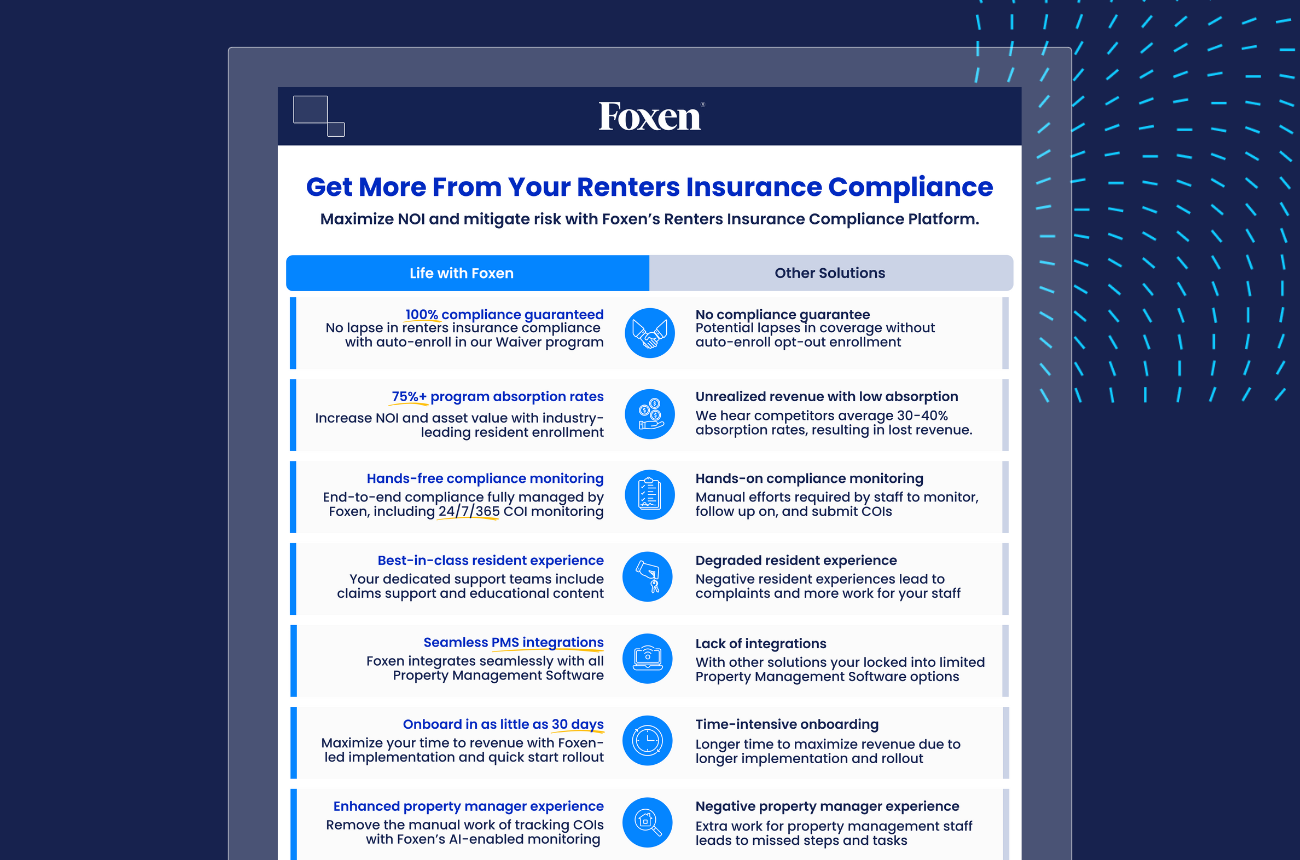
Around 40% of residents required to carry renters insurance don't have active coverage at any given time. When that gap exists and a claim comes in, it defaults to the property's policy, which can carry a $50,000 to $100,000+ deductible.
In this episode of Multifamily Insights, Foxen CEO Kevin Jacobson joins host John Casmon to discuss the real cost of renters insurance non-compliance, why rent reporting is an underused resident benefit, and how Foxen thinks about building a suite of specialized solutions that handle functions important to property operations but outside the core competency of most property management companies. Renters pay 25 to 35% of their after-tax income on rent but receive no credit benefit from it. Despite 85% of renters saying they want rent reporting, only about 10% currently have access to it.
Kevin also shares his perspective on evaluating operators and deals: trust is the primary filter, and anything that feels too good to be true deserves a harder look.
This episode is relevant to multifamily owners, asset managers, and property management companies evaluating renters insurance compliance programs or resident financial wellness benefits like rent reporting.
Hey. We know technology is always changing, but if you are looking to get a leg up on the competition, check out today's conversation with Kevin Jacobson. Now Kevin is with Foxen, and they help landlords and property owners really maximize opportunities in three areas, renter insurance compliance, financial wellness, and pets. That's right, pets.
So if you are a property owner or manager and you're navigating these things and you want to maximize that bottom line, check out today's show. It's right here on Multifamily Insights. Kevin Jacobsen is the CEO of Foxen, where he is leading the modernization of multifamily prop tech with value add solutions and services that increase revenue and reduce risk. Now he's a seasoned operator himself, a former investment banker, and he's previously held leadership roles at high growth SaaS businesses, including as COO of Logic Gate and as CFO at KAPOW.
Let's welcome to the show, Kevin Jacobson.
Thanks for having me, John.
Looking forward to Absolutely, that man.
We were chatting before we hit record, man. You know, I'm living in Cincinnati now. You grew up in Cincinnati, so we got that kind of connection. But for the rest of your background, why don't you take two minutes and fill in some of those gaps?
Yeah, absolutely. So, like you said, grew up in Cincinnati.
Always was interested in business and finance, and learning about where, you know, how you grow, and how you get customers, earn revenue, start a couple businesses when I was younger. And so, yeah, after college, I found myself, as you mentioned, got into investment banking, which I had no idea what that was at the time. But found myself working on technology, M and A transactions, IPOs, things like that, stuff that I had no idea really existed. And it was great learning.
Just got to learn about what makes a company valuable, what are investors looking to invest in. This will come full circle, by the way, when we talk about multifamily. Because in the case context of technology companies, that's an asset class you can invest in, Just like multifamily is an asset class you can invest in. So I started to learn some of the analogous things that go on when you're thinking about capital allocation and investing.
Then did a stint in private equity where you're thinking about what kind of companies would I want to invest in if I'm allocating other people's capital.
And then found what is now my home, which is operating high growth technology companies. So you mentioned two other ones I've worked at, most currently working at a company here based in Columbus, so just up the road from Scentsy Ride Growth, called Foxen.
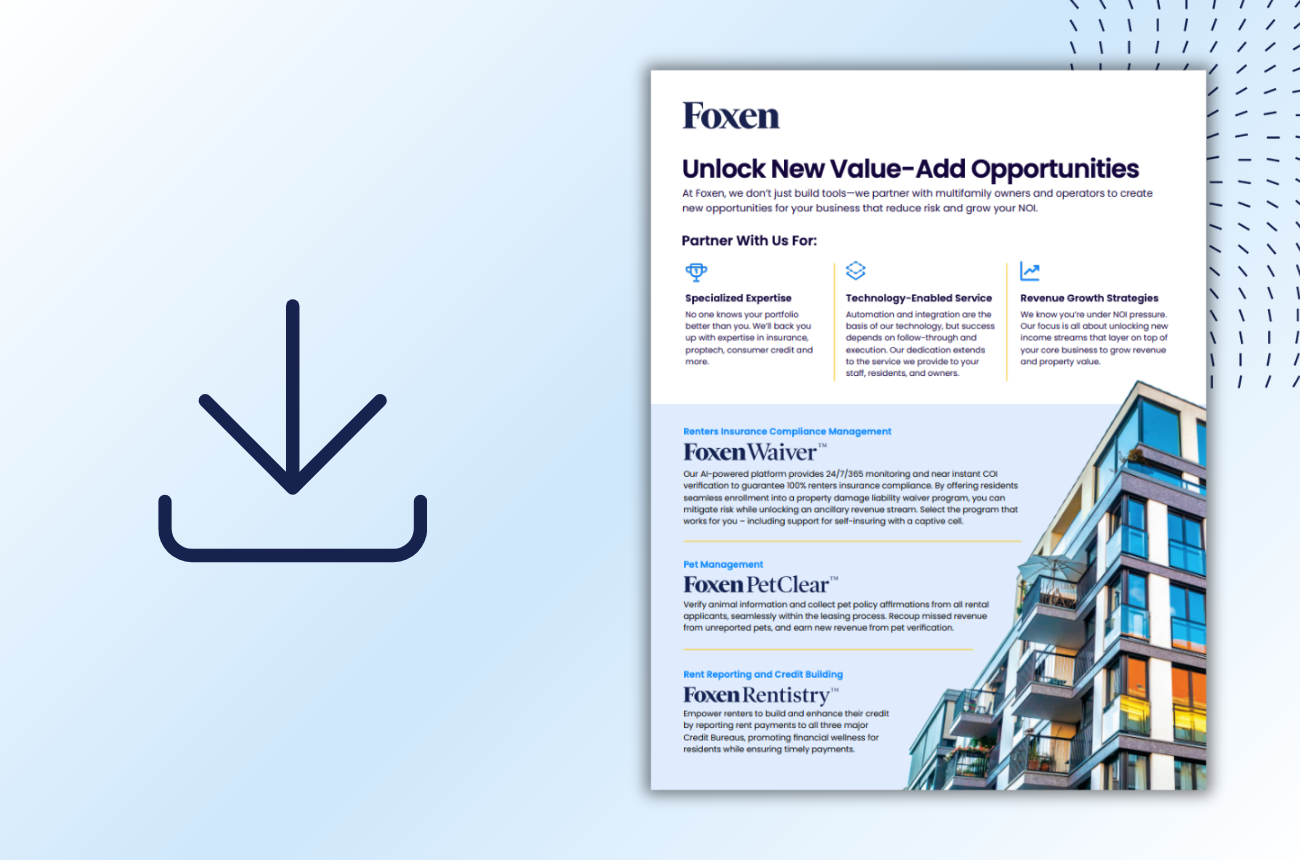
And what we do is we are, as you mentioned, a solution provider to multifamily owners and operators. We offer really three solutions that help them. So you... All things renters insurance compliance. So make sure everyone who's in one of your units has insurance. And that can be really important if you have, say, you know, on the high end can be very consequential fires or flood or water damage, things like that. Can be very expensive.
And you don't wanna be left looking at each other on who's gonna foot the bill. That's really where insurance should come in. But there's a whole thing, a host of challenges making sure that everyone's got something. So we do that.
We also are in the financial wellness business. So we offer renters the ability to report their on time rent payments to credit agencies so they can improve their credit scores, establish a tradeline perhaps for the first time. And that gives you better access to financial products and better car insurance rates and all sorts of stuff like that as as you build out your your financial profile. And then most recently, a new trend that really spiked during COVID was everyone's got a pet now.
In multifamily, and this number will surprise you, can tell me, sixty percent of renters have pets.
Wow.
Some people are shocked by that. It's more the majority now.
And that comes with a whole host of challenges. You gotta collect the right documentation. You gotta From an operator standpoint, your liability's going up, your damage is going up likely, but you want to access that renter pool, people love their pets. There's ways to do that where it's a win win for everybody.
So we help our operators navigate all of that, the challenges that come with that, collecting the right documentation, verifying emotional support animal letters, and things that are kind of in the weeds for that area. So all these are kind of specialized things that you really don't wanna be focusing on if you're in the management business. You wanna be focusing on how do I deliver a great experience to my residents. You wanna be focusing on how do I get applicants to sign leases and deal with the work maintenance orders of the day and things like that.
You wanna outsource some of this to a company like Fox. And we do it, like you said, decrease risk. We could increase revenue by offering these products for the management company and the asset.
And then certainly save time for the property staff. So that's what I've been at Fox for four years. That's what we've been doing.
And yeah, the company's doing really well. We've had a great growth year last year. We're off to a tear this year. We've been around about eight years. Worked with 3,000,000 residents.
And nonetheless, feel like we're just getting started in some respects.
So it's an exciting time.
Yeah. Lots of good stuff there, man. Kevin, you said a couple things. Right? You talked about really three kind of tiers of products and services that you offer.
The first is really renter's insurance compliance. We'll come back to that. The second is really a financial wellness product. And the third is really help around kind of pets.
So the first two I'm familiar with, right? So we talk about renter's insurance compliance.
That...
I think most of hear renters insurance, but maybe that compliance part is a little confusing.
It's a surprise word.
Can you elaborate just a little bit on the renters insurance compliance? And then how does this work for both the owner as well as that resident?
Yeah. So, yeah, the the compliance is the surprise word. You're like, I know where this is going. Then wait, surprise.
So it's really just about...
It's in the lease. It says...
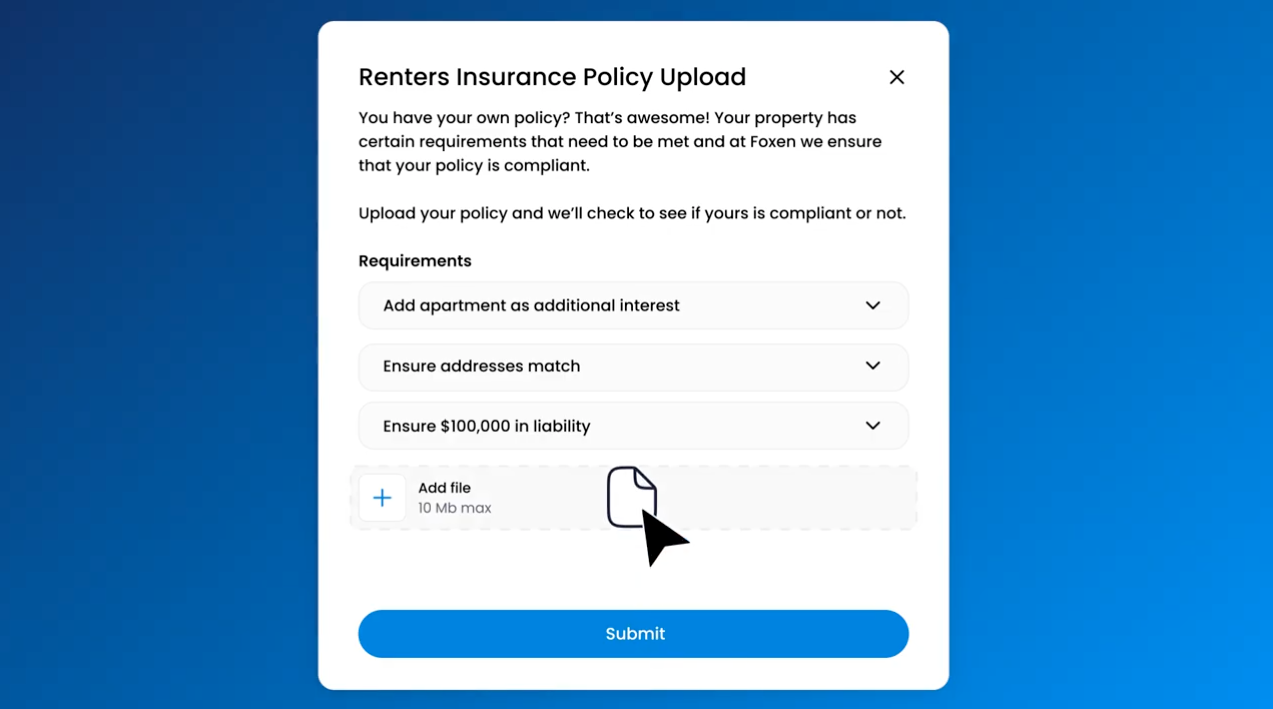
The lease will say, hey. You need to maintain a $100,000 of liability for coverage of some kind to protect against accidental damage and things like that. So the leases are worded differently, but it'll say in the lease it's a requirement to carry this coverage. And historically, what happened was someone submitted their certificate of insurance in paper format or maybe digitally, and then you gave that to the management team or the management company, they gave you the key.
What people started to realize was happening was either in a good case, the policy would lapse and it would get non renewed, and then it wouldn't get paid, and then it'd get canceled. But the management company's none the wiser. Or in the bad case, someone's actually canceling it because they don't wanna pay it. But either way, by some of our metrics, something like 40% of renters who are supposed to have something don't have it.
And so the compliance part of it is making sure that it's zero. So you're making sure that the intention of the lease is satisfied and the renter is compliant with the lease, and we're getting that to zero. And the way that we do that, is kind of the second setup of your question is, we have to deliver a win win win for the resident, the management company, and the owner. So from the owner's perspective, that's a little more simple, but they just wanna make sure there's coverage to protect their asset.
From the management company standpoint, they wanna make sure that there's coverage and that their team isn't spending hours and hours chasing down Tom to get his renter's insurance policy and all that stuff. And the management company, of course, is in the business of providing a great resident experience. So they don't want this to be a problematic situation. So what we do is we basically roll out our solution and we offer residents the ability to get any policy they want, USA, State Farm, anything.
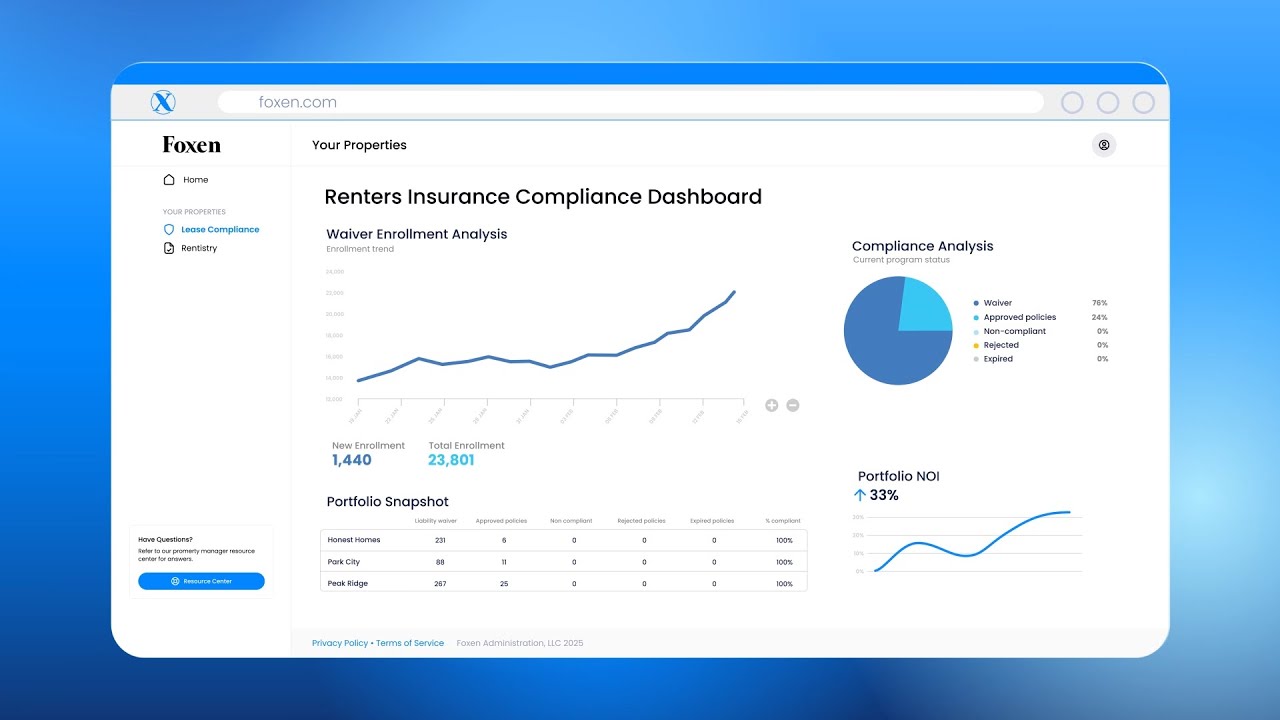
We will track and make sure that that policy is in effect and it's correct based on the terms of the lease. Or if they want to just press the easy button and stay enrolled in what we call a waiver program, they can do that. And they don't have to go out and search and and quote and buying the policy. And that's a...
The the latter option's very cost effective, efficient, straightforward. They...
There's not a lot to do. So what we wanna do is offer the residents choice on how they wanna satisfy it. Everyone's got their own kind of individual price to value to what I want. Maybe you wanna get some very specific contents coverage or something like that unique to you.
You should do that. Go for it.
And so what we do is make sure the residents have options. Make sure the management company doesn't have to worry about this, we take care of it, and we make sure the owner has protection. And that's when... So all that's wrapped up, that's what we call renters insurance compliance.
Yeah. And listen, there's a lot of nuance and complexity to that. And the reason it's important, I want to make sure our listeners understand is when you have or if you have a claim at your property Yeah. That resident has to have coverage as well for that unit, particularly if they're the ones who caused that damage. Or you may have challenges with your own insurance policy getting that taken care of. And on top of that, that compliance is just worth the building.
That normally doesn't cover their belongings. So now you have to have a conversation with them on making sure that they have either a separate policy or they have the appropriate coverage for their belongings. Because again, I think as a resident, you assume you're getting this insurance that is going to cover your stuff, right? I've got these, you know, this shoe collection or this whatever collection.
Yeah. And listen, you will have some really frustrated people if they find out that's not there. So just make sure it's all communicated and that coverage is there. But then you talked about the compliance side too.
And just think about how much time is wasted getting those documents and going back and forth. Yeah. You can't finalize the agreement. So having all that where it's centralized, it's streamlined, but then also, if there's a revenue share component to it, it makes it worth the effort for all parties involved.
Absolutely. And you hit on a on a great critical point, which is if there is no coverage, then you're talking about the property insurance being the coverage. And usually those have a deductible of 50,000, 100... Could be a 100,000 depending upon the size of the building.
So that's... So you ideally want... When there should have been coverage in place for a very straightforward renter's insurance policy or a waiver program or something similar for very low cost, in this case, a $0 deductible, that's much more to your advantage. And then to your point, John, we take that super seriously. Communication transparency and simplicity for residents is key. You gotta make sure everyone knows what they have options.
We're communicating clearly about what option a is and what it isn't, what option b is and what it isn't, and everyone understands the pros and cons, and then people make all sorts of different choices. When we look at like what do people do, you could you could... There's hundreds of permutations of what people do, and that's exactly what we wanna enable.
Yep. The second thing you talked about is financial wellness, which I think is very intriguing. We have not had as much traction in our portfolio on this, but it's something I'm very curious and interested in because, you know, ultimately, you know, the the goal is to help residents, right? Yes, we want them to live in your your apartment community, but ultimately, many of these people aspire to buy a home at some point. So we can have them build up their credit or learn more about financial wellness or things like that. I think it's something that many folks should consider. Talk to me more about kinda how you operate in that landscape.
Yeah. So the solution's pretty simple. When you have a mortgage, to your point, a home ownership, when you pay your mortgage or don't pay your mortgage, that is reported to the credit agencies automatically by the ecosystem of the mortgage ecosystem, the banks and the service providers and so forth. That's already kind of established. In the rental ecosystem, there's no analogous situation. So where it's left is companies like Fox and have to introduce solutions that we can introduce to our clients and say, hey, your renters are paying 25, 30, 35% of their after tax net income on this rent. It's a very important expense to them.
Shouldn't they be getting the benefit of kind of building a financial track record that can obviously come in handy in our economy today where people, you know, any sort of financial transaction you're getting into, whether it's a car loan, car insurance, getting credit cards, things like that, of course they're wondering what's your financial track record. And so ideally, you don't want your paying rent. You paid rent on time for ten years, seven years, eight years. You should get the benefit of that proving that you're a financially attractive person who's gonna pay back a credit card or should get a great rate on a car loan or get good car insurance rates. And that's just not how it works. And so, we started our we created this solution four years ago, and have just been chipping away at trying to get traction, and it's been going well. But we're not even we haven't made a dent yet.
So when you look at We've done some surveys.
85% of renters say, boy, I'd love to have this. And 10% have it. And so we barely made a dent. So we're just continuing on our way. So we call this... This product's called Rentistry.
And we work with the management companies of our clients to introduce it to all residents. Residents who wanna have it can have it. Residents who don't wanna have it can decline it. And usually we see pretty high adoption rates because again, like 85% of renters said like to have it.
And so, yeah. And we report all rent payments to credit agencies. We can do a twenty four month look back. We work with all the property management system. We have to integrate with all the property management systems to make sure we can get access to the right data.
We offer... There's a portal where residents can go in and pull their credit report and access that. They can also use any preferred portal that they want. So, you know, sometimes if they bank with Chase, Chase will have a connection to Experian or Equifax and they can use Chase or they can use Credit Karma, whatever their preferred platform is. Because the data's going to the credit agencies either way. So that's the solution, and it's been getting a lot of traction. Funny enough, actually the state of California realized that this was probably not the ideal situation, and they built some support and ultimately state made law recently that property management companies have to offer this to their residents.
So there's a little bit of tailwinds there. There's couple other states evaluating it. I don't know if that's gonna take over, but it's just an interesting data point.
I don't know if you've seen some of the, there's there's lots of things going on right now in state legislatures and regulations and otherwise that are just trying to get residents more value in different ways, and and that was certainly one. So that's in this category of financial wellness.
Yeah. I I think there's so many things that are intriguing. Right? So one, definitely makes sense with the amount of money and the amount of share of take home pay that goes to rent.
There should be more tracking someone's paying on time. I'm even thinking from a landlord's perspective, right? If you're a property owner or property manager, like, wouldn't it be great to see someone's payment history under rent? Like it's great that you've got a 700 credit score, but what I really care about is your ability to pay rent all the time.
Right? And we obviously know credit score is impacted by so many other factors. So there's that component of it too. And then I know, I remember a couple of years ago, me and my, one of my business partners, we were looking at a platform and they had like rewards.
They did rewards, I think it was like gift cards and other things, they've residents paid rent on time. And it just makes me think that, you know, one of things that you guys deal with in prop tech space, is there's so much innovation that's happening on a, you know, annual, monthly, weekly, probably daily basis. Now with AI taking over as well, how do you guys kind of look at your suite of products, the challenges that are on the marketplace, and the feel, it feels like unending innovation that comes out there from competitors to stay ahead of the market and the change of desires of your client base.
Yeah, so it's a great question, and you're definitely right. Feels like it's a moving target, because it is. And there's other, you mentioned companies that built like rewards platforms or things like that. I think those are great ideas.
That's not something we've prioritized specifically, but I look at that and I say, that's great. And there's 50,000,000 rental housing units in The United States.
We've worked with about 3,000,000 units in our life, so we barely made a dent. And that's the lifetime of the company. And so I think first of all, there can be like, there's multiple winners. And people have different preferences about how they wanna do things.
But I guess first thing, we have a growth mindset, a growth DNA. We're thinking about how can we do more? There are some companies out there that are kinda like, let's just do same as last year plus 5%. And that's not our mindset.
So it starts with that. And then I think you gotta navigate kinda the business strategy questions pretty discerningly. So can easily become just an okay at multiple solutions, or you could be great at a few. And I think that's the challenge that everyone wrestles with in any business when you're trying to grow is how do you not take on too much too soon.
And we've kind of stayed in our lane in the sense that all of the solutions that we provide, to provide we value and interact with the owners, operators, and residents.
These are kind of specialized in nature products. So if you're in the insurance business, that's a whole beast of a business to be in. If you're working with the credit agencies, that's a whole, being a data furnisher, that's a whole beast. And then if you're dealing with anything in the pet space, there's HUD rules and regulations. Obviously, there's tenant landlord legal impacts. There's specialization required to just kind of dig into the specific problem set of pets. And all of that is really not a core competency of a property management company.
Or they don't want it to be at least. They prefer it not be. These are kind of necessary things to get, I want 93%, 94% occupancy in my asset with great residents who are paying on time and I wanna make sure they're happy, and that's the primary focus.
And that takes an incredible amount of folks to do that well. So what we wanna do is build a suite of solutions that just offloads some of these things over time. But we're trying to stay in our lane, like kind of specialized or complex products, not the core competency of a property management company. Need to integrate with all the property management software systems.
We interact with the residents, the management companies, and the owners. So there's just a lot of complexity there. And we're building our capabilities over time to be able to products build over time. Because that's the other thing that we're hitting on is our clients are just really overwhelmed with how many vendors they have to work with.
They would love, if you're one vendor doing one thing, great. That's a great place to start, but you're gonna quickly need to get to be doing some more things because everyone just has too many integrations, too much data over here. I got this login over here. I gotta do this.
I gotta do that. I have 20 vendors just to do some, provide what seems like some basic services. It's just too much for everybody. And that's what I hear regularly from our clients.
So we're trying to do, that is aligned with our growth goals, is if we can do more for our clients and limit the number of vendors they have to have, deliver consistently great services to everyone involved, and these are kind of more specialized areas.
We think there's a really nice business and big business to be built, and we're, you know, I think we're we're in the third inning, but we're... It's starting to get more fun.
Kevin, I love it, man. Hey, for folks who wanna learn more, what is the best way to reach out?
Voxen.com has a ton of information on our... All of our solutions. I'm on LinkedIn if you wanna shoot me a note on LinkedIn, love to hear from you.
And yeah, we're at all major national conferences, many of the regional conferences, you'll see us there swing by the booth.
Anything works.
Love it. Make sure you check them out. This is Kevin Jacobson with Foxen. I've got a couple more questions for you.
We're gonna get to that in our round of insights. When you think you found a great deal, asking the right questions could be the difference in finding a stud or a dud. Listen, we've put together a new guide to help you out. It's called seven Questions You Must Ask Before Investing in Apartments.
In this guide, you're going learn how to uncover red flags, quickly identify underwriting risks, vet sponsors and team members, and confirm key assumptions. Now this is a guide that's going to help you be a better investor whether you're an active investor or you're a passive investor looking to partner with other operators. Asking better questions is the key to identifying great opportunities. So download this free guide, go to our website, kasmincapital dot com slash seven questions.
That's the number seven questions. And you can access this free guide today to make it easy on you though. We've put a link in our show notes. You go to the show notes, you can click that link and access the guide right now.
This guide's gonna help you make better investment choices, asking the right questions to build your portfolio. So be sure to download it today. Alright, Kevin, give me a failure or
an apparent failure that sets you up for later success.
I had, I had multiple times where there was just a difference between what I expected to happen and or what I wanted to happen and what happened. And that would...
You know, like, that could...
I could take you to, like, high high school basketball, college basketball, my first year in in, you know, in an analyst program in Chicago with 20 other analysts and where they stack rank you and you wanna be at the top, of course, right, and all that stuff. And there was multiple moments where there's just that delta between what I wanted to happen and what I expected to happen and what did happen. Happen. And each time I look back now, and for some reason I look back and I'm like, feeling grateful.
For whatever reason, I just kinda dusted myself off and just listened, quick retrospective, and then just get back to work. Right? Because as I learned later in life, you know, like, even if you have an apparent success, the next day comes and that's over. You know?
And this is why people have the Super Bowl hangover, you know, and things like that. It's like they climb to the top of the mountain. They're like, I did it in Super Bowl. And then the next day comes.
So it goes both ways. So that's where I...
That's where my mind goes on that question.
Give me a digital or mobile resource you recommend for our listeners.
I I hate to say it, but I'm I'm just going deep on the AI tools right now. Claude, I'm trying all... I'm trying as many as I can. It's probably a cliche answer these days, but I just think you have to do it and and and just get in there and there's nothing's... No one's gonna it to you. You gotta get in there, work with Claude, work with ChatGPT, work with Grok, work with some of the other tools that are coming out.
Many of them have free accounts. You can just get in there and start playing around and let your mind start to, build an understanding of what's possible now and in the future. So that's where I'm that's where I'm spending my extra calories right now.
Give me the book you've recommended or gifted the most in the last year.
One recently was never split the difference with Chris Boss, which I...
I've always found that, you know, I'm just...
I interact with people a lot. We're talking about negotiation, and people have this misconstrued understanding of negotiation. They think it's like pound your fist on the table and just, like, demand, you know, what you want, especially in the business context. I like it that Chris Chris is coming at it from an FBI negotiator standpoint, which takes you out of the business world and you're just thinking, I'm just interacting with humans.
You know, this is a human being problem, negotiation, and it's not a bad word. And it's really actually about understanding where the other person's coming from and seeing if you can find, you know, common ground. And so he just tells so many different stories from different angles that I think you can't help but read that book and come out with a better understanding of what it means to negotiate and and honestly, a more empathetic, approach to negotiation. And it's...
I like the anti business book sometimes where it's like, we're not just talking about some business story or whatever we kinda get out of our comfort zone.
Give me a daily habit that helps you stay focused or your goals.
I'm big on the...
I've really tried to stay on the pay yourself off first on the day. So, I try to keep my mornings pretty open. I wanna...
If I can get some time with my kids, take them to school, whatever whatever the day case may be. If I can, hopefully do some exercise of some kind and then knock out one or two or three really important things before the meetings of the day and other things start to take shape. You can you can feel good about the day by 10:30. You know, you could feel like I got a w on the board by 10:30.
And then, you know, it's not the rest it's not the rest of the day is wasted, but, you know, you're willing to let the world act upon your day a little more and be more opportunistic and help team and and that sort of stuff. So I really try to do that. It's been helpful. It's hard.
You know, it's hard to do that. And, obviously, you know, emergencies come up and stuff, but that's been helpful to me.
So this is gonna be a little bit different. I wanna tap into your, investing investing background. We got a lot of, LP investors here as well. Give us your number one insight for evaluating a deal or an operator.
I think the old I think the old adages are true. There's no such there's no such thing as a deal that's too good to be true. You know?
So that... I think when you're... When you feel like you've stumbled upon something that's... That feels like it shouldn't be true, we dig a little harder. And then the second thing is, in the macro, I'm gonna take it to the micro context. Let's say you're talking about doing a deal or investing in someone who you can see, who you know, you can understand them personally.
Just find the path to trust.
The old adage in VC traditionally is you're investing in people as much as the ideas.
So if you're putting your money behind great people, even if maybe the specific idea doesn't work out, likely, they're gonna figure out a path. And and so...
But if you're putting your money behind an okay...
A good idea with an okay person, that's probably not where you wanna be, or certainly a bad bad...
A bad idea and a bad person. So I think just, you know, it's the old adages are true I just...
It's...
There's no...
There's nothing too good to be true. It probably is. And, like, let's just just...
Do you trust this person? Like, you wanna...
Can can you can you believe in them? Do they believe in you? Do you believe in what they're doing and and that they'll deliver? And, so I found that those those old adages are true.
Kevin, you're in Columbus. Give us your favorite place to grab a bite to eat.
I, I came from Chicago where there's a restaurant group called Let Us Entertain You, which has a bunch of great concepts. And then I got to Columbus, and there's Cameron Mitchell Restaurant Group here.
There's also Jeff Ruby. Shout out to Cincinnati. I I saw I do frequent that from time to time. But Cameron Mitchell has great restaurants here, The Avenue, The Pearl, and just other other concepts that are keep it keep it fresh. And I feel, lucky that, you know, you have to have a great restaurant group in the city that we can bounce around all sorts of different spots. And every time I bring people in from out of town, they're they're kind of wowed.
A lot of great stuff there. I mean, it's, I've gotta put a couple of those restaurants down the next time I my my usual commute from Cincinnati up to Cleveland to see the family, man. So, I'll stop at Columbus and check out a couple of them. Kevin, great stuff, man.
I really appreciate you breaking down kind of the way Foxen is approaching the marketplace and PropTech, helping us understand how to create that win win win scenario for both residents, the operators, the owners, and understanding like how to navigate, you know. Things are gonna change on a daily basis. It's very competitive, technology continues to evolve, but it really comes down to understanding where you add value. And I think that's a great way for us to think about it.
And I love your point when it comes to investing is find the right individuals. You know, find the right people, good people. Yes, you want find good ideas and investment opportunities, but good people tend to find projects that end up working out. So, if you focus on that, eventually you're going to win.
Again, if folks want to learn more, we're going put a link to Foxen, as well as Kevin's LinkedIn page on the show notes, and make sure you check them out there. Kevin, thanks again for being a great guest and coming on Multifamily Insights. We look forward to staying in touch with you, and I hope you have a great day.